
Floyd County Sheriff’s Most Wanted
The Floyd County Sheriff’s Office posts office contacts, an anonymous tip line, and a nudge toward its Facebook account for news and alerts. That is about it. There is no warrant portal, no sheriff most-wanted page, no photo rule, no rewards, and no posting schedule anywhere on the county's official pages. This absence matters more than people realize. An old name list, a social-media repost, or a third-party identity match simply cannot stand in for a current county roster.
Copying names, charges, or photographs into a static display would be irresponsible without a verified source behind them. The regional jail's custody lookup and a court case file each answer different questions once someone has been arrested. Neither one confirms an active warrant, though. For a booking or custody question about a specific person, start with the county's booking and records routes and confirm which agency actually holds the record.
No published list does not mean no official help. It just means your inquiry has to be record-specific. The sheriff's office handles local law-enforcement questions, while the Floyd Circuit Court clerk can help you find the court record tied to a case. One more quirk: the Floyd County Lockup is listed at the courthouse address, yet the published directory offers no warrant tool, inmate roster, or feed. New River Valley Regional Jail runs its own regional-custody lookup, which only helps once a person is actually held there.
How to Check Floyd County Warrants
With no public Floyd County warrant search available, the documented path is calling the office responsible for the matter. The sheriff, the clerk, and the magistrate can each point you to the right local channel or explain what they may legally confirm. Virginia’s Find a Case page can lead you to public court lookup tools where online access exists. Be aware of its limits, though. It is not a warrant database, and it cannot guarantee current warrant status.
When you contact an office, give the full name plus enough context to pinpoint the possible court matter. Ask whether the issue belongs in district court or circuit court. Anyone possibly facing a warrant should talk to counsel or the court about how to appear or resolve it safely. The published sources offer no basis for treating a search result as permission to act alone.
The Virginia judiciary draws a clear line between its two trial courts. General district courts handle traffic matters, misdemeanors, and preliminary felony hearings, while circuit court handles felony proceedings and other matters in its jurisdiction. Floyd’s combined district-court page and circuit-court clerk are therefore routing contacts, not proof that an online docket shows every pending item. Online case access can be incomplete. A case file and a warrant's current status are two different things.
- Use the Virginia case-finding resource to identify the appropriate public court route when a case number, name, or hearing date is available.
- Call the sheriff, clerk, or magistrate with the name and case context, and ask what that office can confirm about the matter.
- Contact the court or an attorney for the lawful appearance or resolution process if the question concerns the affected person.
Floyd County Sheriff’s Office
100 East Main Street, Room 206, Floyd, VA 24091
(540) 745-9334
Floyd Circuit Court Clerk
100 East Main Street, Room 200, Floyd, VA 24091
(540) 745-9330
Floyd Magistrate Office
100 East Main Street, Room 104, Floyd, VA 24091
(540) 745-9393, limited in-person coverage
Floyd County and VADOC Wanted Records
One official public list exists here. It is Virginia’s VADOC Most Wanted page. Understand what it is. The resource covers statewide corrections fugitives, not a Floyd County sheriff warrant list or every active county warrant. VADOC says the underlying matters can involve officer-arrest warrants, court capiases, and parole-board warrants filed with local or state law enforcement. The roster changes. Names, counts, and images should stay on the official page rather than being copied elsewhere. The state's interface serves here purely as a source reference, not as a gallery of county suspects.
Check the current VADOC Most Wanted resource before relying on any state corrections-fugitive information.
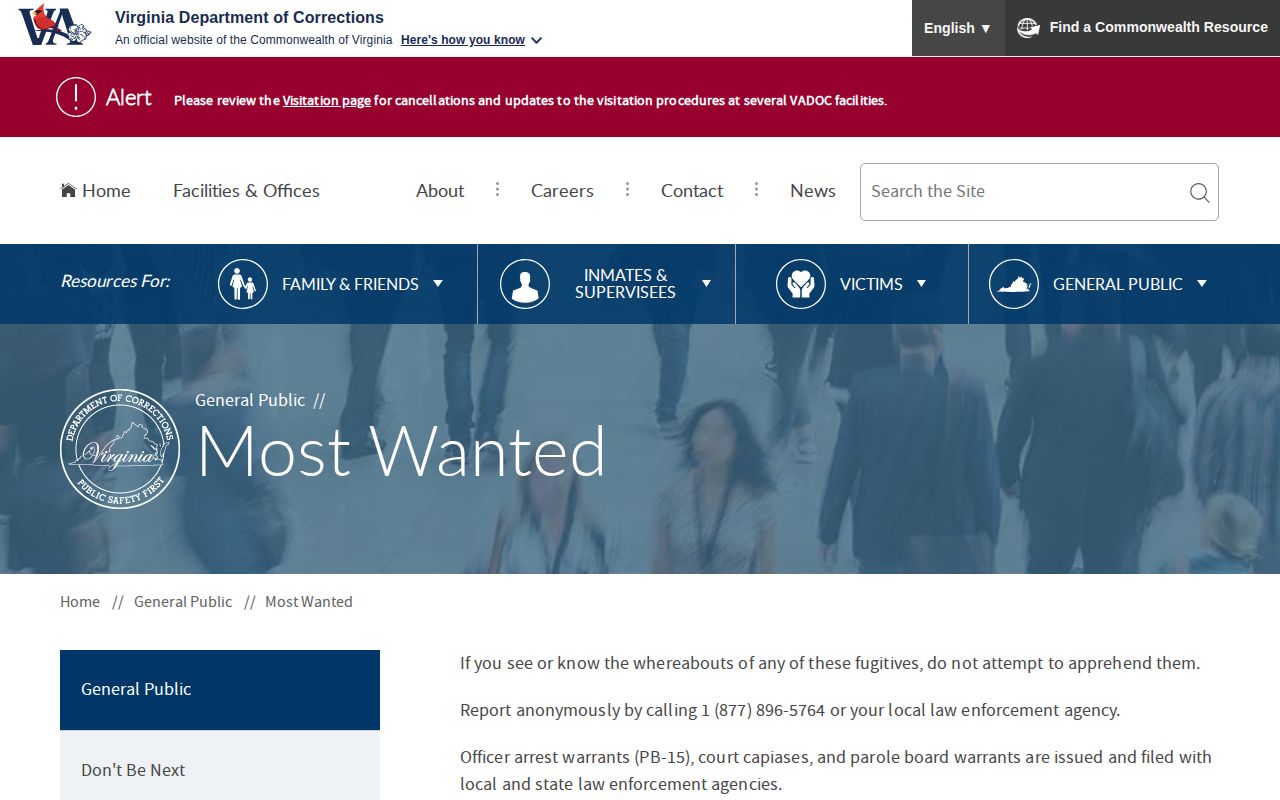
Its purpose is simple: directing reports to law enforcement. It does not create a county arrest record or establish a Floyd County warrant.
| VADOC listing field | What it identifies |
|---|---|
| Photograph | A state-hosted identifying image on the official corrections-fugitive listing. |
| Name and alias | The listed identity information, which still needs law-enforcement confirmation before action. |
| Physical descriptors | Published details such as race, hair, height, sex, eyes, weight, and date of birth. |
| Warrant basis | VADOC describes officer-arrest warrants, court capiases, and parole-board warrants in connection with its list. |
Any table here describes fields on the state list. It does not describe a Floyd County list, which does not exist. A VADOC entry concerns a state corrections fugitive. For a county status question, the agency that owns the local warrant or court file remains the true source.
VADOC custody and local jail custody are different stages entirely. A VADOC locator or wanted entry belongs to the state corrections system, not to an intake at New River Valley Regional Jail. Virginia VINE also splits its notifications. It covers people in local and regional jails separately from VADOC procedures for people in state custody. Both tools can build custody-status awareness where they apply. Neither certifies a warrant, builds a wanted list, or decides a case.
Use Floyd County Wanted Sources Safely
An official resource can give you context. It cannot make you an enforcement officer. Begin with the jurisdiction named in the record, and stay aware of what each source actually covers. When VADOC flags someone as a corrections fugitive, the state list is the place to look; for a possible Floyd warrant, the county contacts are the better route. Neither path means you should approach anyone or try to confirm an identity face to face.
- Open the official VADOC page only when the question concerns a state corrections fugitive, and read the listing in its current form.
- For a possible Floyd County warrant, call the sheriff, clerk, or magistrate and ask which office can address the matter.
- Use a court or attorney contact to arrange a lawful response if the question concerns the person affected by the warrant.
- Send information about another person to law enforcement. Do not attempt a stop, confrontation, or apprehension.
Floyd County has no verified sheriff app pushing live wanted-person notices. The sheriff's Facebook page works as a selective alert channel, not a warrant index. A post can add agency context. Even so, the sheriff, court, and magistrate remain the local path for a real answer.
The county also uses Everbridge for emergency and community alerts. Its stated purpose is notification by text, email, or phone. It is not for warrant research or booking information. Treat the social posts and the alerts as limited public context. A missing post does not mean no warrant or arrest exists. A post still online never replaces a current answer from the responsible office.
Floyd County Warrant Types
Legal labels describe how a matter arose, nothing more. VADOC names three warrant categories for its statewide fugitives. Floyd County officials must confirm whether a local case fits any of them. A capias is court-issued process. Check the documents or the court record instead of guessing from a label.
| Type | Verified context | Appropriate next contact |
|---|---|---|
| Arrest warrant | VADOC identifies officer-arrest warrants in its statewide wanted context. | Sheriff or responsible law-enforcement office. |
| Capias | VADOC identifies court capiases; the controlling court record determines the local status. | Clerk or court connected to the case. |
| Parole-board warrant | VADOC identifies parole-board warrants for its corrections-fugitive list. | VADOC or the responsible law-enforcement office. |
| Bench warrant | A warrant can arise from a court event; the court is the proper place to confirm its status. | The court clerk or an attorney. |
Think of the table as a routing tool. It is not a list of Floyd County cases. No countywide online warrant feed exists here, no searchable docket covers every active warrant, and nothing here offers a shortcut around the responsible court or agency.
Floyd County Tips and Resolution
The sheriff publishes an anonymous tip line for information that may assist law enforcement: (540) 745-9395. The available sources show no Floyd County Crime Stoppers program, no anonymous web-tip service, and no reward policy or cash amount. Don't assume a reward just because a state or national program offers one. Call 911 for any emergency or immediate danger.
VADOC tells the public not to attempt apprehension. It accepts anonymous reports at 1-877-896-5764 or through local law enforcement. That instruction matters most when someone appears on the state list. Worried about your own possible warrant? Contact an attorney or the court and ask how to resolve the matter properly. Hiding from service, concealing your location, or confronting another person is not a lawful way out.
Floyd County Court Records After Arrest
A warrant and a criminal case are different things. They also end at different places. Booking or custody information is an early stage. The court record tracks hearings and the outcome. Virginia's case-finding route points to general-district and selected circuit-court tools. Online availability varies, and no statewide circuit-court search exists. When an online result is unavailable, the Floyd Circuit Court clerk can steer a requester to the right local record.
Charges can be reduced, dismissed, resolved through a plea, or tried. Floyd General District Court handles criminal and traffic matters locally. The circuit court handles felony proceedings and other business within its jurisdiction. Check the actual docket or the clerk for the outcome, not an earlier notice.